
How to Select the Right 33kV SF6 Load Break Switch: Ratings, Bushings and Control
Choosing the wrong 33kV SF6 load break switch rating or bushing configuration can leave a distribution feeder unable to clear loads safely, comply with local grid codes, or accept remote control.
In this article
- Clarify Your Network Requirements
- Key Selection Criteria
- Practical Selection Recommendations
- Comparison: PGS-12 vs PGS-24 vs PGS-40.5
- Summary
Specifying a pole-mounted SF6 load break switch looks simple until you face the options: three voltage classes, two current ratings, ceramic or rubber bushings, suspended or horizontal mounting, and manual, electric or FTU remote control. This guide walks through a repeatable selection path for the GuoYuan PGS-12/24/40.5-20 series so your order matches the network.
1. Clarify Your Network Requirements
1.1 System voltage class
Confirm the highest system voltage of the feeder. The PGS series covers three classes: 12kV (6/10/11kV networks), 24kV (15/17.5/20kV networks) and 40.5kV (33/36/40.5kV networks). For a 33kV system you select the PGS-40.5 class, which is tested to 40.5kV rated voltage and 185kV lightning-impulse withstand.
1.2 Load and transfer current
Match the rated current to the maximum load plus transfer duties. PGS offers 630A as standard (400A available). For a 33kV feeder the 630A rating is the normal choice; choose 400A only for light radial taps.
1.3 Mounting and operation mode
- Mounting: suspended (pole-hanging) or horizontal (pedestal/stand). Pole-hung is standard for overhead lines.
- Operation: manual only, electric, or electric + remote FTU control. Pick remote/FTU if you need SCADA fault-section isolation and automated restoration.
1.4 Bushing and outlet style
Choose the bushing that matches your line termination: ceramic or rubber bushing, molded cable outlet or terminal (clevis) outlet, with or without integrated lightning arresters.
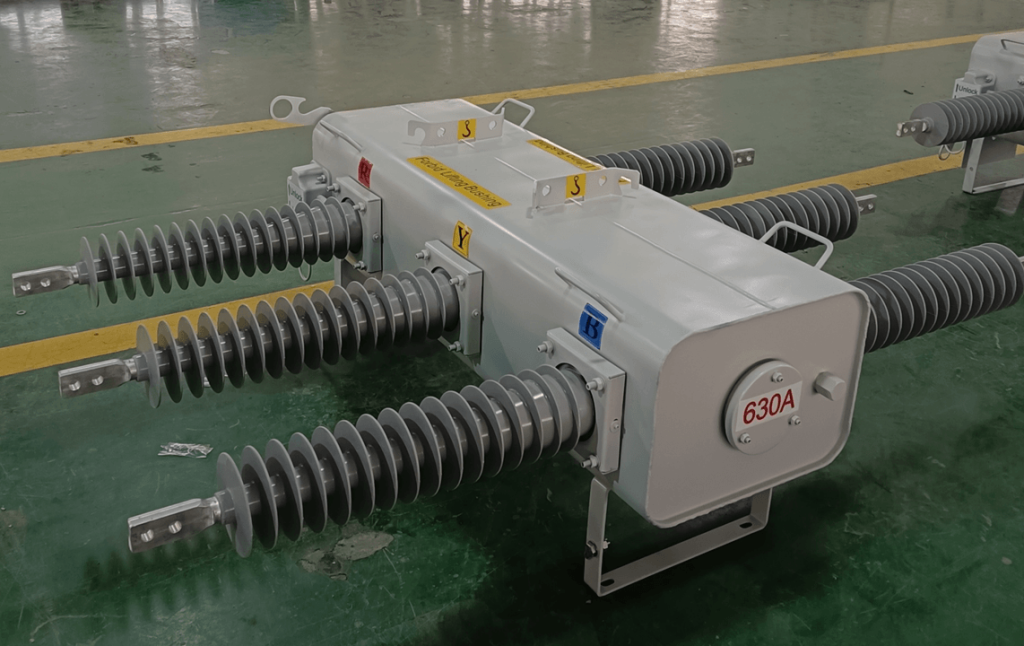
33kV SF6 Load Break Switch
2. Key Selection Criteria
| Criterion | What to verify | Why it matters |
|---|---|---|
| Rated voltage & insulation | 40.5kV class; impulse 185/215kV; PF 95/110kV | Must exceed system highest voltage and withstand transients |
| Rated current | 630A (400A opt.) | Must carry peak load + loop-transfer current |
| SF6 operating pressure | 0.10 MPa (40.5kV) | Drives insulation and leakage-rate assumptions |
| Bushing type | Ceramic / rubber; creepage distance | Pollution level dictates required creepage |
| Enclosure protection | IP44 / IP54 | IP54 preferred for harsh/coastal sites |
| Control interface | Manual / electric / FTU remote | Determines automation capability |
| Standards | IEC 60265-1, GB 40504 | Grid-code acceptance and type tests |
2.1 Creepage distance by pollution level
For 33kV class the bushing creepage distance should follow the site pollution severity (IEC 60815). Coastal, desert or industrial sites need the longest creepage / rubber-shedded bushings. Confirm the value with GuoYuan when ordering.
2.2 Confirm the cable vs line charging duty
If the switch breaks cable charging current (25A) or line charging current (16A) on a frequent basis, confirm the rated values and the ≥400 load-break operations life.
3. Practical Selection Recommendations
3.1 Default configuration for a 33kV overhead feeder
- Model: PGS-40.5 (rated voltage 40.5kV, applicable to 33/36/40.5kV).
- Current: 630A.
- Mounting: suspended pole-hung with bracket (supplied).
- Operation: electric + FTU remote if automated; manual-only for simple sectioning.
- Bushing: rubber bushing with terminal outlet for overhead jumpers; add arresters for lightning-prone areas.
- Pressure: 0.10 MPa SF6; request a pressure gauge if required.
3.2 Ordering checklist
- System highest voltage (33/36/40.5kV).
- Rated current (400/630A).
- Mounting (suspended/horizontal) and bracket needs.
- Bushing type and outlet (cable/terminal) + arresters yes/no.
- Operation mode (manual/electric/remote + FTU).
- Auxiliary voltage (DC 24/48/110/220V or AC 110/220V).
- Enclosure protection (IP44 or IP54).
- Pressure gauge required (yes/no).
4. Comparison: PGS-12 vs PGS-24 vs PGS-40.5
| Parameter | PGS-12 | PGS-24 | PGS-40.5 (33kV) |
|---|---|---|---|
| Rated voltage | 12 kV | 24 kV | 40.5 kV |
| Applicable system | 6/10/11 kV | 15/17.5/20 kV | 33/36/40.5 kV |
| Lightning impulse (ph-e / fracture) | 75 / 85 kV | 125 / 145 kV | 185 / 215 kV |
| PF withstand 1 min (ph-e / fracture) | 42 / 50 kV | 64 / 79 kV | 95 / 110 kV |
| Rated current | 630(400) A | 630(400) A | 630(400) A |
| SF6 operating pressure | 0.07 MPa | 0.07 MPa | 0.10 MPa |
| Peak withstand current | 50 kA | 50 kA | 50 kA |
| Weight (Type M / Type A) | 115 / 135 kg | 125 / 145 kg | 135 / 155 kg |
5. Summary
For a 33kV overhead network the right choice is normally the PGS-40.5, 630A, suspended, rubber-bushing unit, with electric + FTU control where automation is needed. Always confirm system highest voltage, pollution class (creepage), control interface and auxiliary voltage before ordering, and verify the switch is applied as a disconnect-class device backed by upstream protection. A short selection checklist prevents the most common specification errors.
Get the PGS selection checklist (PDF)
A one-page form to capture voltage, current, bushing, mounting and control so your enquiry is complete.
Website: www.guoyuanelectric.com/technology/
Email: INTL@guoyuanelectric.com
Frequently Asked Questions
What ratings must I specify for a 33 kV SF6 load break switch?
Specify rated voltage (40.5 kV class), rated normal current (commonly 630 A), rated short-time withstand current and duration, and mechanical endurance class. Match to your network fault level.
Do I need an integral earthing switch?
For safe isolation during maintenance, specify an integrated earthing switch (grounding switch) with verified making capacity. It is strongly recommended for substation and RMU applications.
Manual, motor or spring operation — which to choose?
Manual lever operation suits local non-critical switching; spring/motor operation is required for remote SCADA control and automatic schemes. Choose based on your automation level.
What standards and certifications should the unit hold?
Require IEC 62271-103 compliance with independent type-test certification (dielectric, thermal, mechanical) from an accredited lab such as XIHARI.
How do I confirm environmental suitability?
Check the enclosure IP rating, pollution/creepage class (IEC 60815), and altitude correction so the sealed SF6 design performs in your climate and elevation.