26 09, 2026

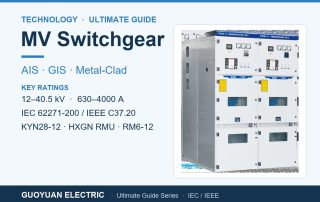
MV Switchgear: The Complete Buyer’s and Engineer’s Guide (12–40.5 kV)

MV switchgear is the metal-enclosed assembly that houses, protects and isolates your circuit breakers and switches. For 12–40.5 kV distribution, specify by four non-negotiables: rated voltage & insulation level, short-circuit withstand / breaking capacity, enclosure type (air-insulated AIS vs SF6 gas-insulated GIS vs solid-insulated), and internal-arc classification (IAC). Match the standard family (IEC 62271 or ANSI/IEEE) to your market before anything else. Medium-voltage switchgear sits at the heart of every substation, industrial plant and renewable connection. It must safely carry load current, interrupt faults, and protect personnel and downstream equipment. This guide explains the technology in plain engineering terms, gives a specification master table, walks through a selection process, and compares the IEC and ANSI standard families — so you can specify the right switchgear for the right duty.
26 09, 2026

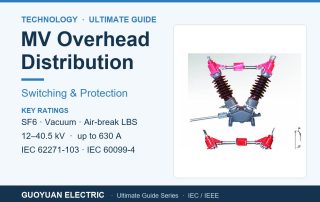
MV Overhead Distribution Equipment: The Complete Utility Guide (11–40.5 kV)

A complete MV overhead distribution line needs five device families: pole-mounted load break switch (SF6 or air), drop-out fuse cutout, disconnect switch, surge arrester, and insulator (composite or porcelain). Specify each by voltage class, fault/interruption rating and standard family (IEC 62271 or ANSI/IEEE). For pole-top load switching, sealed SF6 LBS beats open-air manual switches on safety and maintenance in harsh environments. Overhead MV lines are the cheapest way to deliver power across distance — but every pole is a small substation of protection and switching devices. This guide covers the full overhead equipment family, a specification table, the SF6-vs-air switching decision, a selection process, and the IEC/ANSI split, so utility engineers and EPC specifiers can build a coherent bill of materials.

26 09, 2026

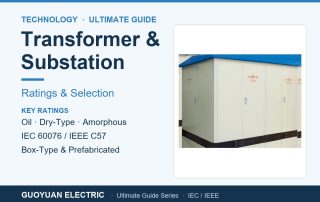
Transformers & Substations: The Engineer’s Guide to Specification

A substation is the interface that steps voltage up (generation/transport) or down (distribution) and protects the network. Specify the transformer by power rating (kVA/MVA), voltage ratio, cooling class (ONAN/ONAF), and insulation level; specify the switchgear & protection around it by the rules in our MV switchgear guide. Prefer oil-immersed distribution transformers for outdoor/grid use and dry-type for indoor/fire-sensitive sites. Transformers and substations are where the grid changes voltage and where faults must be contained. This guide covers transformer types, a specification table, substation one-line composition, a selection process, and the IEC/ANSI split — the companion to our MV switchgear and overhead distribution guides.

26 09, 2026

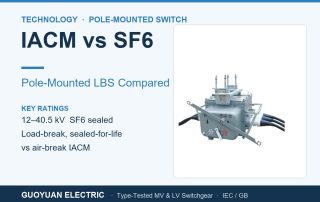
IACM vs SF6 Pole-Mounted Load Break Switch: A Practical Comparison for Utility Buyers

An IACM is an economical, manually operated air-break disconnector / switch mounted on overhead lines — built for infrequent isolation. An SF6 pole-mounted load break switch is a sealed, maintenance-free, gas-insulated device engineered for reliable, repeated load switching in harsh outdoor environments. They look similar on a pole, but specifying an IACM for load-switching duty creates real safety and reliability risk. Many utility engineers, EPC specifiers and distribution planners still confuse the IACM (Manually Operated Overhead switch / air-break disconnector, sometimes referred to as an IA1CM switch-disconnector) with an SF6 pole-mounted load break switch. Both are mounted on medium-voltage overhead lines, and both can sit in a sectionalizing or isolation role — but they are fundamentally different devices with different arc-quenching media, operator-safety profiles, and maintenance demands.

26 09, 2026

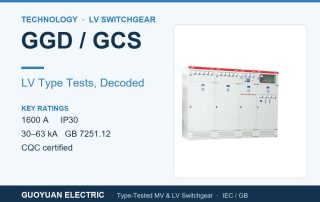
How to Read a Low-Voltage Switchgear Type Test Report: GGD vs GCS (IEC 61439 / GB 7251.12)

For low-voltage switchgear, a type test report (to IEC 61439 or China's GB 7251.12) proves the assembly's rated current, short-circuit withstand/breaking capacity, enclosure protection (IP), temperature-rise limits, and dielectric strength. Using our own CQC-certified reports as the example: GGD is rated up to 1600 A with short-circuit capability in the 30–63 kA class at IP30; GCS reaches 2500 A and 50 kA.

26 09, 2026

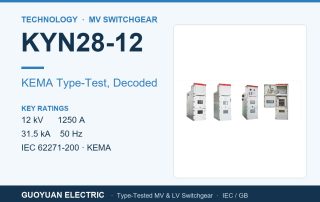
How to Read a Metal-Enclosed Switchgear Type Test Certificate: A KYN28-12 KEMA Worked Example

A type test certificate (such as a KEMA certificate for a KYN28-12 metal-enclosed switchgear) is the independent, third-party proof that a design — not a single sample — satisfies IEC 62271-200. The five numbers that decide whether it fits your project are: rated voltage, rated normal current, short-circuit withstand current, the standard/clause coverage, and the accrediting laboratory. Learn to read those and you can vet any switchgear offer in minutes.

29 08, 2026

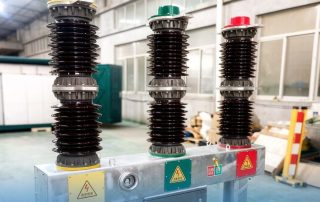
11–40.5 kV Outdoor SF6 Circuit Breaker: Technical Analysis of Gas-Insulated Pole-Mounted Switching

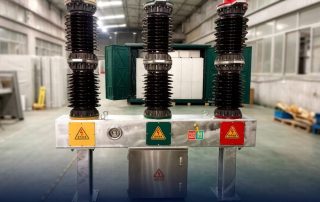
When an outdoor SF6 circuit breaker is specified for a medium-voltage distribution network operating between 11 kV and 33 kV (up to 40.5 kV), the engineering decision hinges on understanding how sulfur hexafluoride gas insulation, arc-quenching physics, and pole-mounted mechanical design interact under real-world conditions — from tropical humidity to high-altitude UV exposure. This article provides a comprehensive technical analysis of outdoor SF6 circuit breakers for the 11–40.5 kV range, with particular focus on the widely deployed LW8-40.5 model as a representative design.

29 08, 2026

How to Select the Right 11–33 kV SF6 Circuit Breaker: Ratings, Bushings and Control

Selecting an SF6 circuit breaker for an 11–33 kV distribution network is not simply a matter of matching nominal voltage. The wrong choice of short-circuit rating leaves your feeder unprotected during faults; underspecified bushing creepage leads to flashover in polluted environments; and omitting remote-control capability can force crews to climb poles unnecessarily during outages. This guide walks through every parameter that matters when specifying an outdoor SF6 circuit breaker.

24 08, 2026

Dielectric Performance Type Testing for Outdoor SF6 Load Break Switches — A PGS(FLW) Case Study

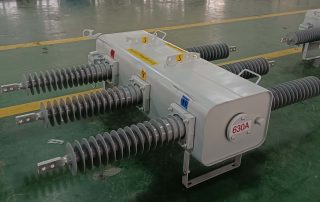
For outdoor pole-mounted SF6 load break switches operating in harsh environments — coastal salt spray, industrial pollution, tropical humidity, or high-altitude UV exposure — dielectric integrity is not merely a specification item: it is the primary determinant of service continuity and personnel safety. This case study presents the complete dielectric performance type test results for Guoyuan Electric's PGS(FLW)-40.5/630-25 SF6 insulated load break switch, conducted at XIHARI's Changzhou high-voltage laboratory in June 2023. We examine the test methodology, actual applied voltages, and what the results mean for field engineers.

24 08, 2026

PGS(FLW) Series SF6 Insulated Load Break Switch — Full Voltage Range Type-Certified (12 kV to 40.5 kV)

For utilities and industrial operators managing medium-voltage distribution networks spanning multiple voltage levels, sourcing load break switches from a single manufacturer with consistent design philosophy and full type-test coverage across all required voltages simplifies procurement, spare parts management, and maintenance training. This article presents the PGS(FLW) series SF6 insulated load break switches from Guoyuan Electric — a single product family available at 12 kV, 27 kV, and 40.5 kV — each backed by independent dielectric performance type test reports from XIHARI, China's premier high-voltage apparatus research institute.